

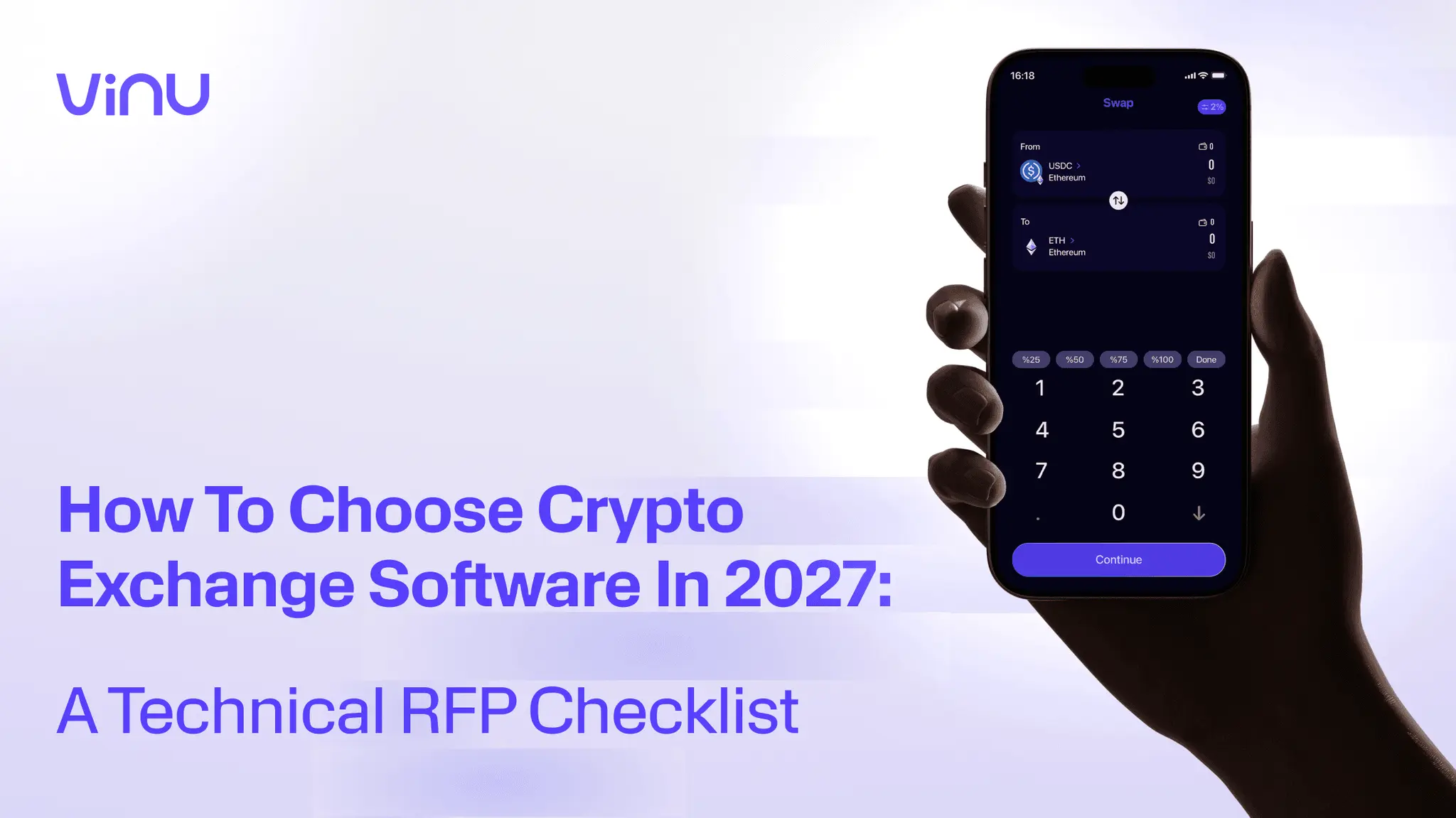
A polished trading interface is easy to demonstrate. A reliable cryptocurrency exchange is much harder to prove.
For fintech founders, financial institutions, and businesses planning a crypto exchange launch in 2027, selecting the right software provider is one of the most consequential technical decisions.
The challenge is not simply finding a platform that supports trading. It is identifying an infrastructure partner capable of delivering security, operational control, regulatory adaptability, and long-term scalability.
The best way to evaluate crypto exchange software is through a structured Request for Proposal (RFP) that tests the underlying infrastructure, not just the visible features.
This checklist explains what to ask, what evidence to request, and which risks deserve attention before signing a contract.
1. Evaluate the Trading Engine Beyond Performance Claims
The matching engine is the operational core of a centralized cryptocurrency exchange.
Software providers frequently highlight execution speed and transaction capacity. These metrics matter, but they should never be accepted without context.
Your RFP should establish how the system behaves under realistic trading conditions.
Questions to ask:
- What order types and matching rules are supported?
- How is matching latency measured under different workloads?
- Can the platform maintain order integrity during sudden volume spikes?
- What happens to active orders during service interruptions?
- Can the trading engine scale independently from other services?
Request documented benchmark results, test conditions, and recovery scenarios.
A provider should explain not only how quickly orders execute, but also how the system protects transaction integrity when something goes wrong.
2. Examine Custody and Wallet Security
A crypto exchange handles more than trades. It also manages asset movements, withdrawals, customer balances, and sensitive operational permissions.
This makes wallet architecture and custody integration critical components of vendor selection.
Questions to ask:
- Does the platform support hot, warm, and cold wallet workflows?
- Which private key management models are available?
- Can withdrawal limits and approval policies be configured?
- Are administrative permissions separated by role?
- Can the platform integrate with an institutional custody provider?
- How are failed or interrupted withdrawal operations handled?
Security should be evaluated as an operational system rather than a collection of individual features.
For example, multi-signature authorization may strengthen transaction controls, but it does not replace access governance, transaction monitoring, or auditability.
The right custody architecture depends on the institution's operating model, regulatory obligations, and risk tolerance.
3. Verify Regulatory Adaptability
There is no single compliance configuration suitable for every cryptocurrency exchange.
Licensing obligations, customer verification requirements, transaction monitoring rules, and reporting responsibilities vary across jurisdictions.
A software provider should therefore demonstrate how its infrastructure can support changing regulatory requirements without extensive redevelopment.
Questions to ask:
- Which KYC, KYB, and AML providers can be integrated?
- Can customer and transaction restrictions be configured by jurisdiction?
- How are compliance decisions recorded?
- Does the architecture support Travel Rule integrations where required?
- Can regulatory reporting workflows be adapted to local requirements?
Ask vendors to distinguish between native software capabilities, third-party integrations, and services requiring additional development.
Most importantly, do not confuse compliance-supporting technology with a guarantee of regulatory approval. Legal eligibility remains dependent on the applicable jurisdiction and operating entity.
4. Assess Liquidity and Banking Integrations
An exchange may have an excellent matching engine and still fail to provide a competitive trading experience without sufficient liquidity.
Similarly, a platform may support crypto transfers but lack the banking and payment infrastructure needed for its intended business model.
The RFP should cover both areas.
Questions to ask:
- Can the platform connect to multiple liquidity providers?
- How are market data feeds synchronized?
- What happens when a liquidity connection fails?
- Which banking and payment interfaces are supported?
- How are deposits, withdrawals, and transaction records reconciled?
Providers should identify existing integrations separately from proposed custom development.
This distinction affects implementation timelines, technical dependencies, and the total project budget.
5. Test Operational Resilience and Scalability
Scalability is not only about supporting more users.
A growing exchange must maintain reliable operations as trading volume, integrated networks, market data requirements, and administrative workloads increase.
Ask vendors to explain their deployment architecture and demonstrate failure recovery procedures.
Your technical evaluation should cover:
- Service isolation and independent scaling
- Infrastructure monitoring and alerting
- Backup and disaster recovery procedures
- Deployment and rollback mechanisms
- Incident response responsibilities
- Recovery time and recovery point objectives
A performance claim without a defined testing environment offers limited procurement value.
For a deeper explanation of the architectural challenges, see How to Scale a Cryptocurrency Exchange.
6. Understand the Total Cost of Ownership
The initial software proposal rarely represents the entire cost of launching and operating a crypto exchange.
Infrastructure hosting, external integrations, custody services, maintenance, additional modules, and ongoing technical support can substantially affect the final budget.
Ask every vendor to provide a transparent breakdown of:
- Initial licensing or development fees
- Infrastructure and hosting costs
- Third-party integration expenses
- Security testing and maintenance
- Support and incident response arrangements
- Future customization and expansion costs
Compare proposals using the same assumptions, including projected trading activity, supported networks, expected integrations, and service requirements.
A lower initial quote does not necessarily mean a lower long-term operating cost.
7. Compare Delivery Models and Vendor Responsibilities
Not every business needs the same exchange development model.
A new fintech venture may prioritize speed to market, while an established financial institution may require greater customization and integration control.
Common approaches include:
Turnkey development: A technology partner delivers a complete exchange environment, including development, integrations, deployment, and implementation support.
White-label software: An established exchange architecture is configured around the client's brand, operating model, and technical requirements.
Managed services: The provider supports ongoing monitoring, maintenance, updates, and selected infrastructure operations.
Modular development: Individual components are integrated into an existing platform without replacing its entire architecture.
Explore how Vinu Digital's white-label exchange solutions support configurable platform development.
Before choosing a model, clarify software ownership, data portability, source code access, service responsibilities, and contractual exit provisions.
8. Use a Weighted RFP Scorecard
A structured evaluation prevents impressive demonstrations or individual features from dominating the purchasing decision.
An example evaluation framework is:
| Evaluation Area | Suggested Weight |
|---|---|
| Trading engine and performance | 20% |
| Security and custody | 20% |
| Compliance and integrations | 20% |
| Scalability and resilience | 15% |
| Delivery and operational support | 15% |
| Total cost of ownership | 10% |
These weights are illustrative. Institutions should adjust them according to their risk profile, business model, and procurement requirements.
Score each category using supporting evidence rather than promotional claims.
Technical demonstrations, architectural documentation, references, and contractual commitments can help distinguish established capabilities from future development promises.
How Vinu Digital Approaches Exchange Infrastructure
At Vinu Digital, we approach cryptocurrency exchange development as an integrated infrastructure challenge.
Our centralized exchange software combines trading, liquidity connectivity, wallet infrastructure, administration, security controls, reporting, and integration capabilities through a modular architecture.
Depending on business requirements, organizations can adopt turnkey, white-label, managed, or module-based solutions.
This flexibility allows institutions to evaluate their infrastructure around operational needs rather than a fixed set of features.
The objective is not simply to launch a trading interface. It is to establish a platform that can be operated, monitored, secured, and expanded as the business develops.
Frequently Asked Questions
What should be included in a crypto exchange software RFP?
An exchange software RFP should specify trading requirements, wallet and custody architecture, security controls, regulatory integrations, liquidity connectivity, scalability, support commitments, and total ownership costs. Vendors should provide evidence of their capabilities and identify any functionality requiring custom development.
Is white-label crypto exchange software suitable for financial institutions?
White-label software can be suitable when the platform provides sufficient customization, security, integration flexibility, and operational control. Institutions must evaluate the solution against their specific regulatory, governance, and technical requirements.
How can buyers verify crypto exchange software performance?
Buyers should request documented benchmark conditions, stress tests, failure recovery demonstrations, and architecture reviews. Performance should be evaluated against expected workloads and independently agreed acceptance criteria.
What is the most important factor when choosing an exchange software provider?
There is no universal deciding factor. The strongest choice balances technical reliability, custody security, compliance adaptability, operational support, commercial transparency, and the ability to meet the institution's specific requirements.
Final Thoughts
Choosing cryptocurrency exchange software in 2027 should be an evidence-based decision.
A strong RFP helps organizations identify operational risks before those risks become expensive production problems.
Rather than asking which provider offers the most features, ask which provider can demonstrate how its infrastructure will perform, adapt, and recover under real operating conditions.
Planning to launch or modernize a cryptocurrency exchange?
Contact Vinu Digital to discuss your technical requirements and explore an infrastructure approach aligned with your business.