






BLOG DETAIL
Meet Noode: RPC Ready. Go Build.
October 7, 2025 09:50 AM
KEY:#web3#noode#node-as-a-service#developer tools#crypto infrastructure
As Web3 development accelerates, one bottleneck keeps slowing teams down — infrastructure. Node setup and maintenance, latency and uptime issues, multi-chain management, and lack of visibility all stand in the way of fast iteration.
Noode removes these operational burdens with a Node-as-a-Service layer: connect to multiple chains through a single API key and get your app running in minutes. Your team focuses on building the product, not the backend.
Why Do You Need a “Node API” Layer?
Web3 applications constantly need reliable RPC access to read chain data (account balances, event logs, blocks…) and broadcast transactions. Running your own full node:
- Brings hardware, disk, bandwidth, and maintenance costs
- Requires scaling and load-balancing as usage grows
- Can cause multi-day downtime when sync/indexing issues arise
A Node API provider externalizes those costs — offering high availability, up-to-date state, healthy response times, and version/client management handled for you.
Noode’s Approach
Noode, developed by Vinu Digital and launched as a joint initiative with Clovera, aims to deliver the most efficient node infrastructure for the global developer community — from a Turkey-based technology hub.
Our focus:
- Fast integration: Create an account → copy your key → add the endpoint.
- Multi-chain support: Ready-to-use RPC endpoints for popular EVM networks and testnets.
- Scalable plans: Start free, upgrade as your needs grow.
- Developer-first experience: Clean docs and plug-and-play code examples.
- Responsive support: Quick assistance when you need it.
Why Noode Makes It Easier
- Zero setup: No client versions, disk space, or peer configs to manage.
- Predictability: Node health issues no longer block your release cycle.
- Rapid testing: Connect to a chain within minutes for PoCs and MVPs.
- Effortless scaling: Increase your plan or quota — no code changes needed.
Example Use Cases
1) NFT Mint Night
You’re running a limited-edition mint with an artist. Launch time 8:00 PM — thousands of simultaneous read/write calls.
- Problem: Sync delay + limited connections → failed mints.
- With Noode: Connect to a balanced, ready endpoint; handle the traffic reliably throughout the event.
2) Micro-Transactions
Players buy and sell in-game items — small txs, huge volume.
- Problem: High-frequency smart-contract calls overload a single VM.
- With Noode: Reads return faster, and transaction publishing stays smooth.
3) DeFi Integration
You’re fetching prices, monitoring events, and executing trades across multiple DEXs.
- Problem: Heavy multi-chain operations and event listening overhead.
- With Noode: Use one API key for several networks and simplify your watch/write flows.
4) Enterprise PoC
You’re developing an on-chain record system for a public institution.
- Problem: Node setup, security reviews, and budget approvals delay progress.
- With Noode: Launch your PoC instantly with a ready RPC and focus on core objectives.
Get Started in 5 Minutes
- Sign up for free and get your API key.
- Choose your network.
- Add the HTTP or WebSocket endpoint to your app.
- Monitor from the dashboard: view request volume, latency, and success rate — upgrade as you grow.
Example: Node.js fetch
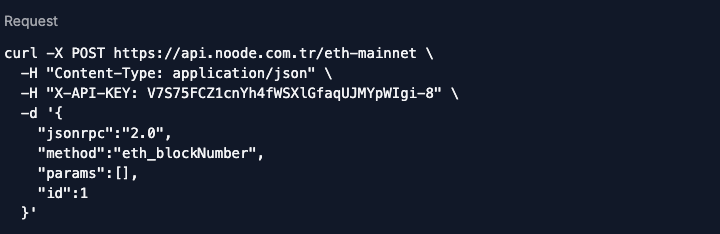
Broadcasting a transaction:
Pricing & Plans
Noode offers three tiers — from startup to enterprise:
- Basic — $0/month: 25 requests/s, 10M requests/month, limited networks, shared regions, community support. Provides a solid foundation for MVPs, hackathons, learning, and testing scenarios.
- Pro — $399/month: 1,000 requests/s, 1B requests/month, advanced analytics, priority support. Scalable and predictable capacity for production-ready projects.
- Enterprise — Custom pricing: Dedicated node clusters, unlimited throughput, unlimited apps & webhooks, uptime SLA, VIP engineer support, volume discounts. Designed for teams with high compliance and performance requirements.
An annual billing option is available with 20% savings, helping growth-oriented teams plan their budgets efficiently.
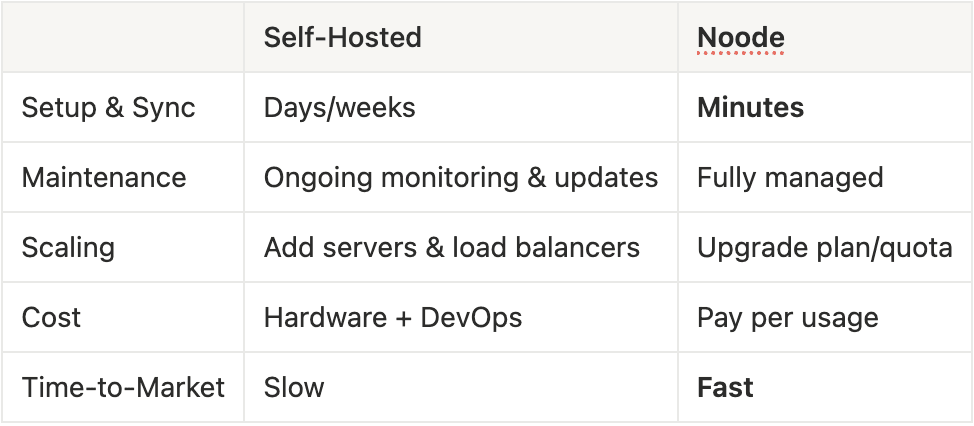
Node API vs. Self-Hosted Node
Migration Steps
- Get your API key.
- Define your network/endpoint.
- Replace your RPC URL.
- Gradually test: route a small share of traffic to Noode, measure, then scale up.
Web3 products scale best when infrastructure friction is minimal.
Noode gives developers a simple promise:
“We run the nodes, you build the product.”
By using a Node API layer, you eliminate setup, maintenance, and scaling headaches and ensure a stable, predictable user experience.
Start now with the Free Plan, and upgrade as your project grows.