






BLOG DETAIL
OTC Trading: The Silent Power in the Crypto Market
November 13, 2025 06:16 PM
KEY:#otc trading#otc likidite#slippage
The Anatomy of a Red Candle
Close your eyes and imagine you are a “whale” looking to sell millions of dollars worth of Bitcoin on a public exchange. When you hit the “Market Order Sell” button, your massive order “devours” the order book in seconds. The price starts at $60,000, but it consumes all buy orders down to $58,000 before your order is filled.
A massive, blood-red candle appears on the charts. This phenomenon is called “slippage.” You end up closing your trade millions of dollars cheaper than you expected, causing panic in the market.
This is the biggest nightmare for institutional investors. What they need is confidentiality, deep liquidity, and price stability. This is precisely where the “quiet power” of crypto trading comes into play: OTC (Over-the-Counter) Trading. This model offers the only way to execute massive transactions without anyone noticing and without affecting the market.
What is OTC: The Oldest Form of Trading
In its simplest terms, OTC (Over-the-Counter) is a trading model where buyers and sellers agree on a transaction outside a public exchange (order book) through a private intermediary (OTC desk).
So, is this model new? Absolutely not. In fact, it predates even organized exchanges and represents the most primitive form of trade: a direct agreement between two parties without an intermediary.
The term “over-the-counter” derives its name from the physical bank “counter” where shares not listed on the stock exchange were sold in the 19th and 20th centuries. Since that time, this model has been the “quiet power” in traditional finance (large bond transactions, Forex), allowing large funds to trade without disrupting the market.
In short, the crypto world did not invent this model. It simply adapted this centuries-old method to digital assets to solve the “whale problem” and the “slippage nightmare” mentioned in the introduction.
Key Difference from Exchanges: No Order Book
On a standard exchange, your order enters a public “order book” that everyone can see. In OTC trading, there is no such thing.
The process differs in the following three points:
- No Order Book: The transaction is executed through a “price quote” mechanism. The buyer or seller submits their request to an OTC desk; the desk then offers a “This is my locked-in price for you” quote.
- Price Privacy Guaranteed: This agreement is entirely confidential. Even if you purchase 1,000 Bitcoin, other market participants will not be aware of this, and there will be no panic.
- Parties Negotiate Directly: The price is locked in at a fixed level determined through negotiation between the two parties, not based on the current order book’s depth.
Who Uses It?
This privacy and price stability naturally attracts users with a specific profile. OTC is preferred by players who need large volumes rather than small-scale daily traders:
- Institutional Investors: Investment firms, banks, or large technology companies seeking to add cryptocurrency to their assets.
- Hedge Funds: Professional trading funds that enter or exit large positions.
- HNWI (High-Net-Worth Individuals): High-net-worth individual investors, i.e., the “whales” of the market.
- Miners: Large mining pools that must sell the cryptocurrency they produce to cover their operational costs without depressing the market.
Challenges of Centralized Exchanges (CEX)
Centralized exchanges are great for individual users, but they can create difficulties for “whales” who need massive trading volumes:
- Slippage: As we saw in the “whale” scenario at the beginning, a massive order consumes the order book and shifts the price. In institutional volumes, this “slippage” translates to millions of dollars in hidden costs.
- Strategy Leakage (Loss of Confidentiality): Transparency is the rule on exchanges, but for institutional players, this is a “strategy leak.” A large public order alerts bots and other investors who engage in front-running, further distorting the price against you.
- Insufficient Depth: A stock exchange may have high daily “volume,” but the “depth” of its order book is often insufficient to accommodate a single large transaction without disrupting the price. This situation can completely crash prices, especially in altcoin markets.
- Operational Delays: While individual KYC takes minutes, verifying the complex legal structure of a fund or company can become an “operational nightmare.” Customer onboarding processes at standard exchanges can take weeks for corporate needs.
Over-the-counter (OTC) trading stands out as a solution that will breathe life into institutional investors by overcoming these four limitations.
Advantages of OTC Trading
Issues such as “slippage,” loss of privacy, and operational slowness created by centralized exchanges are the reason for the existence of OTC desks. Institutional investors find four key advantages they seek on these platforms:
Privacy and Anonymity
This is perhaps the most critical promise of OTC trading. When you trade with an OTC desk, the transaction does not appear on public order books. Your million-dollar purchase or sale remains completely “invisible” to other market participants.
This confidentiality protects the strategic plans of large investors. They are shielded from bots and speculators seeking to manipulate the market or engage in front-running. Once the transaction is complete, the market remains unaware of what occurred; this grants institutional players the freedom to execute their plans without anyone noticing.
Price Stability (Zero Slippage)
When the OTC platform offers you a “quote,” this price is usually locked in. For example, when you accept the price quote of “$60,000 for 1,000 Bitcoin,” your entire transaction will be executed at this price. There is no possibility of the price slipping to $59,500 or $59,000.
This means a “zero slippage” guarantee. Investors know exactly how much they will pay or receive before entering a trade. This predictability eliminates millions of dollars in hidden costs (slippage) and is vital for corporate treasury management.
Deep Liquidity
OTC desks gather liquidity from a different source than the order books of centralized exchanges. They typically have direct access to their own private liquidity pools, other large institutional investors, mining companies, and global liquidity provider networks.
This “pooled” liquidity is much deeper than the fragmented liquidity found in the order book. As a result, even a large trade that could potentially “break” or “dry up” the order book of a centralized exchange can be easily executed without affecting the price, thanks to the deep liquidity network of the OTC desk.
Customizable Trading Conditions
Centralized exchanges operate with strict rules; you either place a market order or a limit order. OTC trading, on the other hand, is like a “tailor-made” service. Parties can adjust the trading conditions to suit their needs.
For example, a fund may wish to execute a very large purchase over five days, at specific times of the day, by dividing it into parts at a fixed price. Or it may wish to use another digital asset, or even an RWA via tokenization, as the payment method instead of fiat currency. Such complex and customized agreements are only possible with the flexible contract structure offered by OTC desks.
How Do OTC Trading Platforms Work?
While appearing to be a simple structure where “two parties agree” from the outside, institutional OTC platforms operate an advanced infrastructure to ensure trust, liquidity, and settlement. The process works very differently from public exchanges.
Buyer and Seller Matching Logic (RFQ Model)
Unlike the “order book” model of centralized exchanges, OTC platforms operate on a “Request for Quote” (RFQ) model:
- Request: An institutional buyer submits a request to the platform stating, “I want a price quote to buy 500 BTC.”
- Pricing: The OTC platform looks to its own liquidity pools or its network of affiliated liquidity providers to fulfill this request.
- Offer: The desk presents the buyer with an offer such as, “My locked price for you is $60,100.” This offer is typically valid for a very short period, usually 10–30 seconds.
- Accept/Decline: If the buyer accepts this price, the transaction is “locked in” at that moment, and the buyer knows they will receive 500 BTC at $60,100 with a “zero slippage” guarantee.
Liquidity Provider Infrastructure
The greatest strength of OTC platforms is how they gather liquidity. They typically source this liquidity from two main sources, rather than public order books:
- Dealing Desk: The OTC desk acts as the direct counterparty to the trade, using its own capital (its own crypto and cash inventory). It assumes the risk itself, but provides the customer with instant liquidity from a single source.
- Agent: The OTC desk acts as an intermediary. It receives the customer’s request and forwards it to its own private network. It finds the best price, matches the buyer with the seller, and earns a commission from this transaction.
KYC/AML Processes
Privacy and anonymity mean that transactions are hidden from the market, not from regulators. Legitimate institutional OTC platforms are subject to KYC and AML procedures that are at least as strict as those of centralized exchanges, and often even stricter.
The acceptance of a fund or company onto these platforms is much more comprehensive than an individual investor registering on the stock exchange. Company documents, legal authorizations, and documents proving the source of funds are carefully examined. This ensures the platform’s legal compliance and the security of all parties.
Security Mechanisms: Escrow (Deposit)
The primary goal in large-scale transfers on OTC platforms is to ensure the safe transfer of cash and crypto assets. Two main mechanisms are used to reduce this “counterparty risk”:
- Traditional Escrow: This is the most common method. An OTC desk or a contracted bank/custodian acts as a trusted third party. The buyer sends the cash to the escrow account, and the seller sends the crypto asset to the escrow wallet. Once the escrow agent confirms that both assets have arrived, they release the assets to the respective parties simultaneously.
- Smart Contract-Based Trust: Especially in crypto-to-crypto (DeFi OTC) transactions, this escrow process can be automated. A smart contract locks both parties’ assets (e.g., 1,000 ETH in exchange for 3,000,000 USDC) and only when both assets reach the contract does it automatically execute the exchange.
Settlement Steps
The settlement process, which begins after the price is locked in, refers to the moment when assets are finally transferred:
- Funding: The parties send the agreed-upon assets to the escrow account/wallet.
- Verification: The escrow agent verifies that the funds have arrived.
- Exchange: The agent sends the cash to the seller’s bank account and the crypto to the buyer’s wallet address.
In the crypto world, this process is much faster than the settlement periods in traditional finance (T+2, i.e., 2 business days) and is usually completed on the same day (T+0) or the next day (T+1).
The Strategic Importance of OTC Trading for Institutions
For large financial institutions, OTC is not an “alternative route,” but the only viable way to enter the digital asset market. While managing portfolios worth billions of dollars, they must keep their strategies confidential, secure the best price, and minimize operational risks.
The “retail”-focused structure of centralized exchanges cannot meet these institutional requirements. OTC desks fill this gap perfectly, offering them the following strategic advantages:
- Large Portfolio Management and Market Entry: When an investment fund decides to allocate 1% of its assets to Bitcoin, this could mean a purchase worth hundreds of millions of dollars. The only place they can make this purchase without causing chaos in the market is through OTC desks. This allows them to both enter the market “quietly” and liquidate their existing positions without affecting the market.
- Contributing to Market Stability: OTC platforms act as a kind of “shock absorber.” They “absorb” massive buy or sell orders that could disrupt the market in their own deep liquidity pools before they reach public order books. If these large transactions were reflected on exchanges, we would see much higher and more destructive volatility in crypto markets. By managing this large volume behind the scenes, OTC contributes to the overall health and stability of the market.
- Secure Transition to Institutional DeFi: The new trend is the convergence of OTC and DeFi. Institutions want to benefit from the high yields and automated financial tools offered by DeFi. However, they cannot do this in anonymous and unregulated public pools. Institutional OTC platforms serve as a gateway to KYC/AML-compliant, “permissioned” DeFi pools. They enable institutions to benefit from the advantages of decentralized finance while ensuring full regulatory compliance.
- The Backbone of Stablecoin and RWA Transactions: Institutional use is not limited to buying and selling Bitcoin or Ethereum. Two large companies engaged in international trade may want to make a $50 million payment much faster and cheaper using a stablecoin such as USDC or EURC instead of the bank SWIFT system. They cannot use a centralized exchange to execute a transaction of this volume; they perform the “fiat–stablecoin” conversion directly through an OTC desk.
Additionally, with the rise of RWA tokenization, tokenized real estate, bonds, or stocks are also beginning to be traded through OTC desks. The specialized liquidity and legal infrastructure required for trading these assets falls within the expertise of traditional OTC platforms.
Vinu Digital: A New Generation Approach in Corporate OTC Infrastructure
This strategic dependence of the corporate world on OTC trading raises a critical question: Who will build this complex, highly secure, and fully compliant infrastructure?
For a bank, fund, or brokerage firm to establish its own corporate OTC desk from scratch entails a significant operational burden and cost in terms of technology development, integration into global liquidity networks, KYC/AML modules, and legal compliance.
This is where Vinu Digital steps in as a reliable solution partner. Vinu offers the Vinu OTC Platform, a modular technology backbone designed to enable institutions to quickly launch their own branded OTC services within weeks. Vinu Digital is more than just an intermediary; it is a technology provider that enables institutions to become intermediaries themselves.
Vinu OTC Platform Solution: Key Features
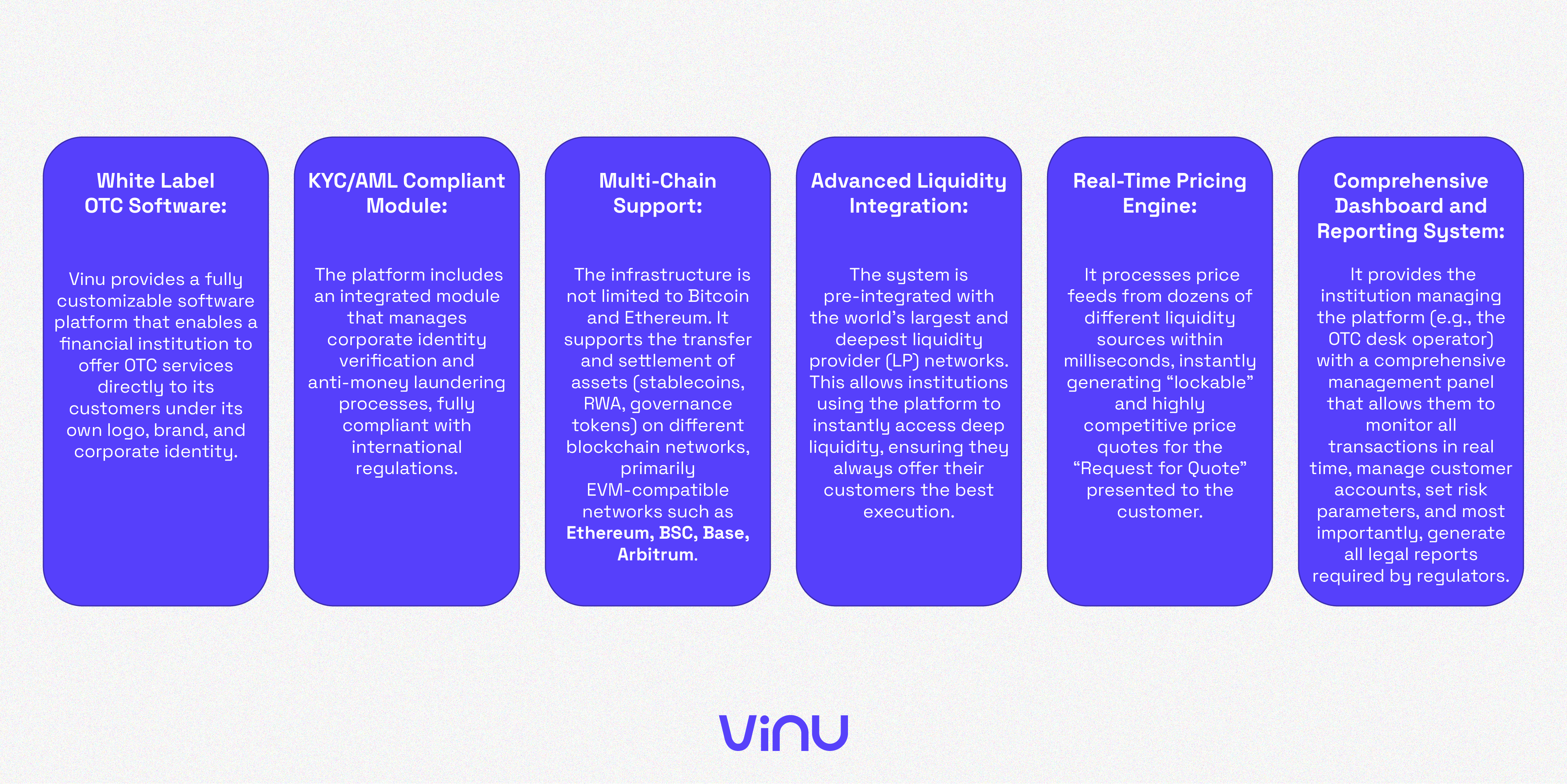
This technology infrastructure enables Vinu Digital to execute large-volume Bitcoin/stablecoin trades for corporate treasuries or funds without impacting the market and with confidence; allows exchanges and brokerage firms to offer a “white-label” OTC liquidity desk under their own brand; and enables fund managers and brokerage firms to access a dedicated and secure trading panel for portfolio balancing and investing in tokenized assets such as RWA. This infrastructure provides all the components an institution may require.
How OTC Markets Are Changing Corporate Finance?
OTC trading emerged as a “necessity” at the dawn of crypto markets; however, today it stands at the very center of the intersection between traditional and digital finance. This model appears poised to be the key to the full integration of corporate finance with digital assets and blockchain technology.
There are three main directions in which this field will evolve in the future:
- RWA Tokenization and Secondary Markets: Considered one of the biggest financial revolutions of the future, RWA involves creating digital representations of real estate, artworks, bonds, or private company shares on the blockchain. So, where would you sell a $10 million tokenized building share? The answer is not public exchanges, but institutional OTC desks with the necessary legal and technical infrastructure for these assets. OTC will provide the specialized liquidity and legally compliant secondary market that RWAs require.
- Global Stablecoin Transfers and Settlement: Institutions and even central banks are increasingly recognizing the speed and low cost that stablecoins offer in international trade and cross-border payments. Billions of dollars in global money transfers will be conducted via corporate OTC platforms using “fiat–stablecoin” and “stablecoin–fiat” conversions as an alternative to the SWIFT system. This could turn OTC desks into the new intermediaries of global settlement.
- Mainstream Adoption as Regulations Clarify: As legal frameworks for crypto assets become clearer worldwide (MiCA in Europe, potential regulations in the US, etc.), conservative institutional players who were previously waiting on the sidelines will also begin to enter the market. The only gateway through which this massive capital can enter the market in a “safe” and “compliant” manner will be fully regulated institutional OTC platforms. Regulations will transform OTC from a “niche” area into the mainstream standard for digital asset management.
In short, OTC is not only “quiet” in digital asset transactions, but also stands out as the most “stable” growing model.
To Conclude
At the beginning of our article, we started with a “whale” scenario that plunged a centralized exchange into chaos with a single order. This noisy, chaotic, and “visible” face of crypto trading is just the tip of the iceberg. Beneath the surface lies a massive, silent force that provides the market’s true depth and stability: OTC (Over-the-Counter) Trading.
As we can see, OTC is the only valid model that provides the privacy, zero price slippage, and deep liquidity that the corporate world needs to enter digital asset markets. These platforms act as a “shock absorber” for the entire ecosystem by executing massive transactions behind the scenes, away from market shock waves.
Today, OTC trading is no longer just a tool used by large Bitcoin investors; it has also become the cornerstone of RWA, institutional stablecoin transfers, and the transition to regulation-compliant DeFi.
For this transformation to take place, the infrastructure built by technology providers such as Vinu Digital plays a critical role. These next-generation platforms provide the complex, secure, and legally compliant technological backbone that organizations need, enabling them to confidently step into the world of digital assets.
Ultimately, the term “silent power” refers not only to the ability to execute large-volume transactions without disrupting the market, but also to having strategic control over the financial infrastructure of the future.