

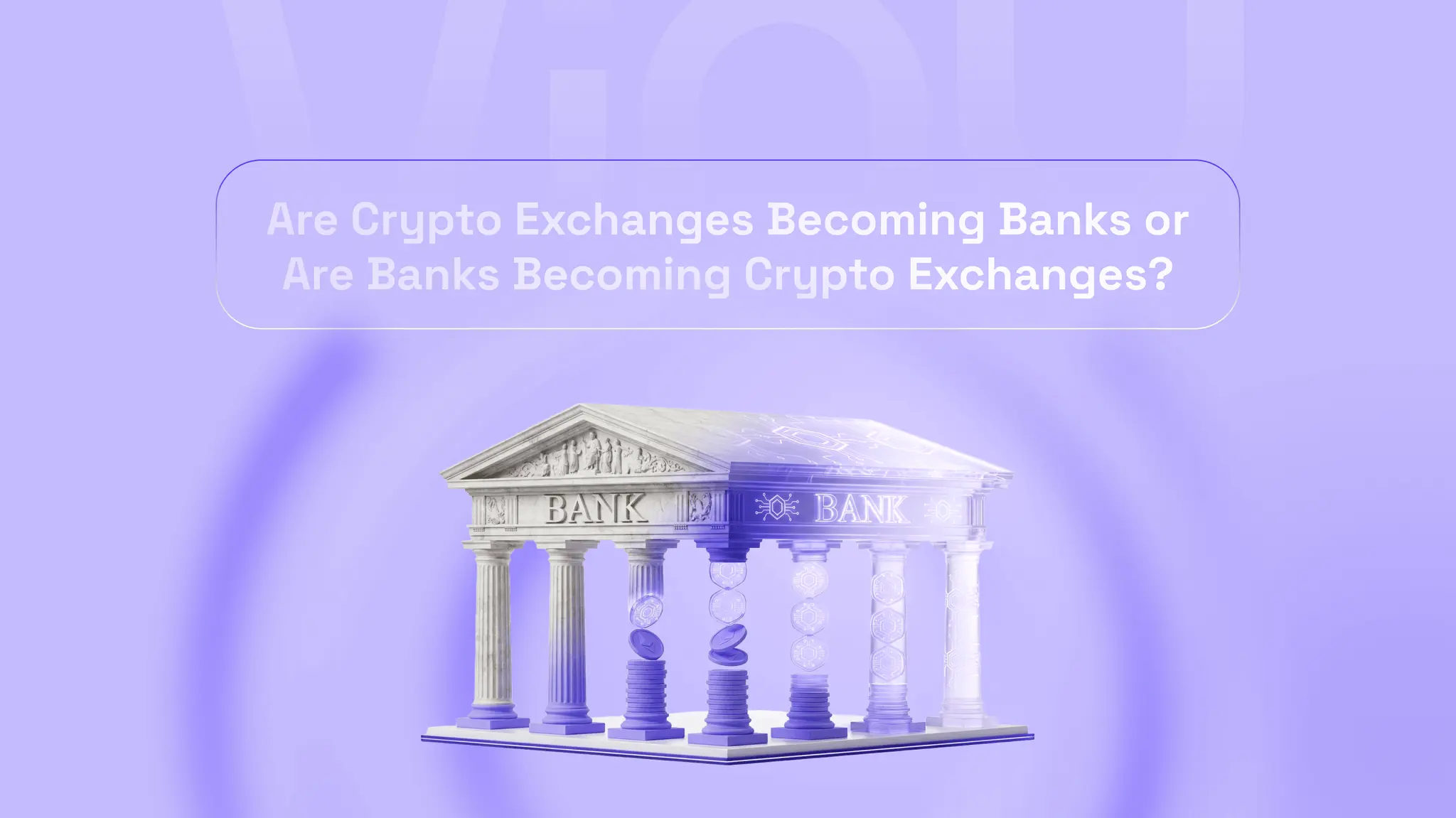
The boundary between banks and crypto exchanges is becoming harder to define through products alone.
Banks are expanding into crypto custody, customer-directed execution, stablecoin services, tokenization and blockchain-based settlement. Crypto exchanges, meanwhile, are strengthening custody, fiat connectivity, payments, treasury controls, institutional trading and compliance infrastructure.
From the outside, it can look as if exchanges are becoming banks while banks are becoming exchanges. The reality is more precise: the institutions remain different, but the infrastructure beneath them is converging.
For banks, fintech companies and exchange founders, the strategic question is who can connect trading, custody, wallets, liquidity, payments, compliance and blockchain settlement in a secure and modular way.
Vinu Digital positions its technology around that need, connecting exchange software, custody, wallet systems, blockchain services and cloud architecture around the institution’s operating model.
Are Crypto Exchanges Becoming Banks?
Not exactly. Exchanges are adding services associated with financial institutions, but that does not automatically make them commercial banks.
Banks operate within a legal and economic model built around deposits, payments, lending, regulated balance sheets and prudential supervision. Crypto exchanges originated around digital asset markets.
Their traditional stack focused on order matching, liquidity, wallet management and blockchain settlement. Institutional adoption has expanded that stack to include custody, customer asset segregation, treasury controls, surveillance, reporting and resilient infrastructure.
These are no longer simply trading features. They are elements of financial market infrastructure.
This is why Vinu Digital approaches exchange software beyond the matching engine. Trading remains central, but institutional platforms increasingly need custody, liquidity, security, wallet management, reporting and operational controls to work as one architecture.
Exchanges may not be becoming banks, but they are increasingly expected to operate with financial-institution-grade discipline.
Are Banks Becoming Crypto Exchanges?
Banks are moving in the opposite direction.
They already possess customer relationships, fiat payment connectivity, compliance organizations and institutional trust. What many historically lacked was the blockchain-native technology layer.
In the United States, the OCC has clarified that national banks and federal savings associations may conduct activities including crypto-asset custody, customer-directed execution, certain stablecoin activities and participation in distributed ledger networks, subject to applicable law and sound risk management.
A bank therefore does not need to build a public crypto exchange to provide digital asset access.
A possible architecture could be:
Customer → Bank Interface → Compliance → Execution Routing → External Liquidity → Custody → Reporting
The bank keeps the customer relationship while execution can occur through external exchanges, market makers or liquidity providers.
For institutions taking this route, modular infrastructure matters. Vinu Digital can support exchange technology, wallets, custody, blockchain connectivity or cloud services without requiring the institution to replace its existing stack.
The goal is not to turn a bank into an exchange, but to add crypto-native capabilities where they are needed.
The Real Convergence Is Happening in the Infrastructure
Traditional banking is built around accounts, centralized ledgers, intermediaries and permissioned systems. Blockchain markets introduce wallets, cryptographic authorization, smart contracts, programmable assets and continuously available settlement networks.
Future financial platforms increasingly need to support both. A customer may see one portfolio, while the infrastructure must distinguish between a bank deposit, stablecoin, tokenized deposit, tokenized security and crypto asset. Each may require different custody, transaction, settlement and compliance rules.
The principle is simple:
Unify the experience without incorrectly unifying the infrastructure.
This is why modularity matters. Trading, custody, wallet, blockchain and compliance components should work together while remaining independently configurable.
Stablecoins and Tokenized Deposits Are Bringing the Models Closer
Stablecoins are one of the clearest bridges between traditional finance and blockchain markets.
They have expanded beyond crypto trading into payments, treasury operations, settlement, cross-border transfers and programmable financial applications.
Banks are approaching programmable money from another direction through tokenized deposits.
A tokenized deposit remains a liability of the issuing commercial bank while operating through programmable infrastructure. BIS Project Agorá has demonstrated how tokenized commercial bank deposits and tokenized central bank reserves can support atomic, multi-currency cross-border settlement.
The significance is not only speed: payment conditions, compliance logic and settlement can increasingly interact within the same workflow.
For banks, this means blockchain connectivity cannot remain an isolated experiment. Production systems need APIs, transaction controls, wallets, monitoring, security and resilient cloud environments.
Vinu Digital’s blockchain and cloud capabilities are relevant here because institutions can establish these foundations first, then connect execution, custody, tokenization or wallet services as their strategy develops.
Custody Is Where Banks and Exchanges Meet Most Clearly
Custody may be the strongest point of convergence.
Banks understand asset safekeeping and governance. Crypto adds cryptographic control.
Institutional digital asset custody can require secure key generation, HSM infrastructure, MPC or multisignature controls, transaction policies, asset segregation, reconciliation and immutable audit records.
Banks entering crypto custody therefore need blockchain-native security. Exchanges moving toward institutional clients need stronger governance, segregation, reporting and operational controls.
Both arrive at a similar requirement: secure, policy-driven and auditable digital asset custody.
At Vinu Digital, custody is designed as part of the wider infrastructure rather than an isolated wallet feature. It needs to communicate with customer balances, exchange ledgers, transaction controls, treasury operations, blockchain networks and reporting systems.
24/7 Finance Changes the Architecture
Crypto markets have normalized continuous operation.
Markets trade around the clock, blockchains process transactions on weekends and stablecoins move outside traditional banking hours.
A bank or fintech entering digital assets therefore needs more than an always-on interface. Treasury, reconciliation, wallet operations, compliance and infrastructure must also support continuous activity.
This makes cloud architecture part of the digital asset strategy.
High availability, observability, automated recovery and scalable infrastructure become operational requirements. Vinu Digital combines cloud and DevOps capabilities with digital asset infrastructure so exchange, custody, wallet and blockchain systems can support continuous financial activity.
The Future Financial Stack Will Be Modular
Banks and exchanges are unlikely to become one universal type of institution. Their technology stacks, however, will become increasingly composable.
A modern digital asset stack can include identity, trading, custody, wallets, digital money, blockchain connectivity, compliance, settlement and cloud infrastructure.
Institutions can combine these layers differently.
A bank may own the customer relationship while using external liquidity. An exchange may operate the trading layer while connecting to an independent custodian. A fintech may own the experience while integrating both.
This is the model Vinu Digital is built to support: infrastructure should adapt to the institution’s business model rather than force every institution into the same monolithic platform.
What Should Banks and Exchange Founders Focus on Now?
Banks entering digital assets should think beyond “adding crypto trading.” They need to decide how custody, liquidity, execution, reconciliation, compliance and 24/7 operations will fit into existing systems.
Exchange founders face the reverse challenge. As they move toward institutional clients, payments, custody or tokenization, they need stronger segregation, treasury controls, reporting, security and resilience.
Both sides arrive at the same question:
Can the platform add new financial capabilities without rebuilding the core system?
That question increasingly determines how quickly an institution can adapt as digital asset markets evolve.
So, Who Is Becoming Whom?
Neither side is simply turning into the other.
Banks are adopting blockchain-native capabilities. Exchanges are adopting institutional financial controls. Their licenses, balance sheets and regulatory obligations remain different, but their technology requirements increasingly intersect.
Both are moving toward the same capabilities:
Custody. Execution. Tokenization. Programmable money. Real-time settlement. 24/7 operations. Automated compliance.
The advantage will belong to institutions that connect both models effectively.
Banks bring trust, regulated operations and fiat connectivity. Crypto-native platforms bring programmable assets, continuous markets and blockchain settlement.
The next generation of financial infrastructure is being built where these capabilities meet.
FAQ
Are crypto exchanges becoming banks?
Not necessarily. Exchanges are adding custody, payments and institutional services, while commercial banking remains a distinct regulated model.
Can banks offer crypto services?
Depending on jurisdiction and permissions, banks can participate in crypto custody, execution, stablecoin-related activities and blockchain infrastructure.
Do banks need their own crypto exchange?
No. Banks can integrate execution technology and route orders to external liquidity while retaining customer, compliance, custody and reporting controls.
Why are tokenized deposits important?
They can bring commercial bank money into programmable infrastructure while preserving the bank-deposit relationship and enabling programmable payments and integrated settlement.
Build the Infrastructure for the Next Financial Model
Whether you are a bank, fintech or exchange, the architecture should support more than today’s use case.
Vinu Digital develops modular solutions across crypto exchange software, digital asset custody, wallet infrastructure, blockchain systems and cloud architecture, helping institutions connect traditional finance with digital asset markets without rebuilding their technology stack for every new product.
Talk to Vinu Digital about your digital asset infrastructure strategy.