

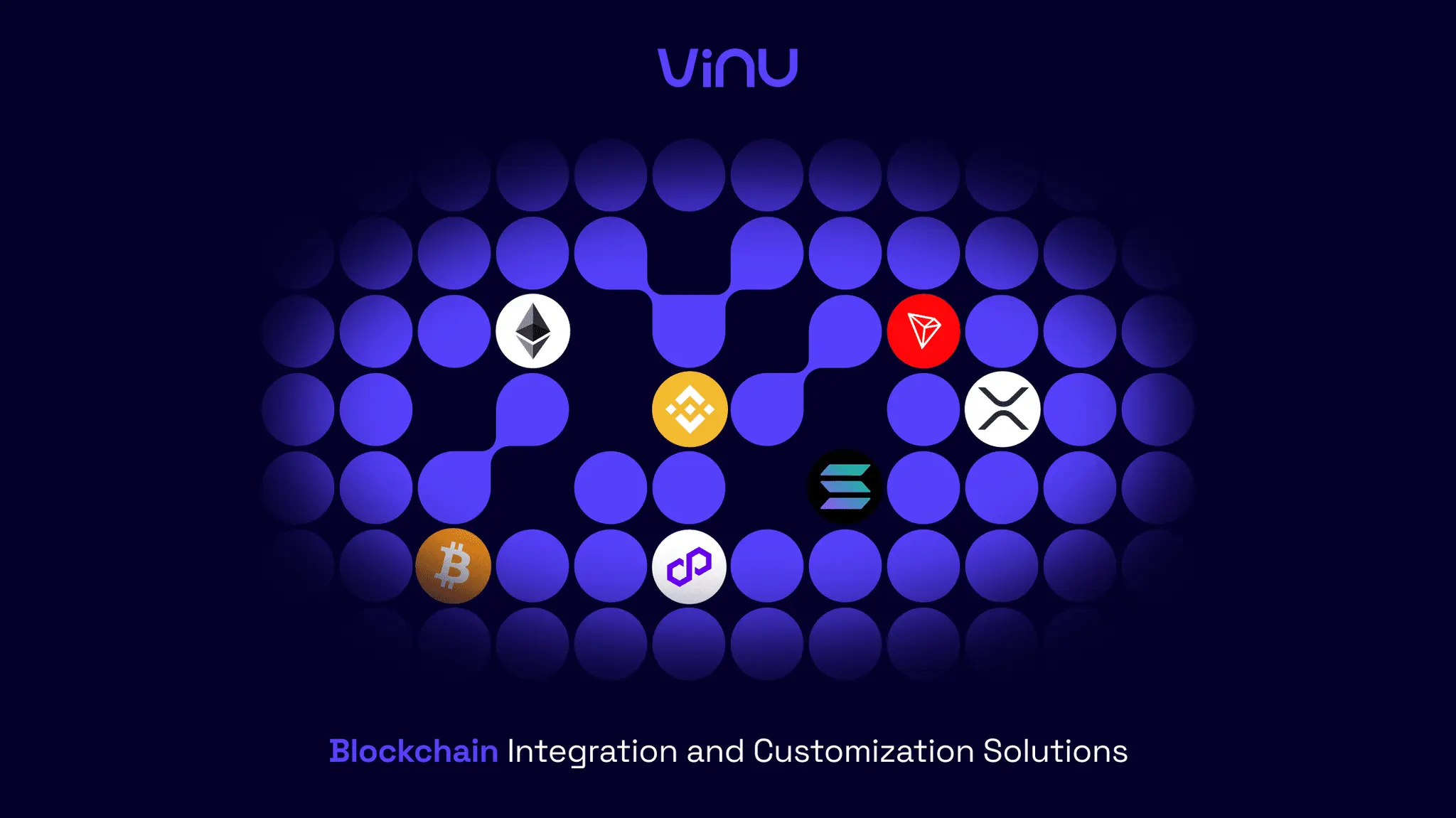
Blockchain integration allows a cryptocurrency exchange to support new networks, digital assets, and transaction workflows without treating every addition as a separate platform rebuild. For exchange operators, the challenge is not simply connecting to a blockchain node. Each integration must work with deposits, withdrawals, wallet balances, trading services, asset records, and operational controls.
Vinu Digital develops blockchain integration and customization solutions for cryptocurrency exchanges and Web3 platforms. Our work covers networks such as Ethereum, BNB Smart Chain (BSC), and the XRP Ledger, with configurations adapted to the technical requirements and business model of each platform. The objective is a manageable, modular architecture.
What Does Blockchain Integration Mean for a Cryptocurrency Exchange?
Blockchain integration is the process of connecting an exchange's existing infrastructure to a blockchain network or a supported digital asset. It involves more than displaying an asset in a trading interface. The platform must be able to recognize deposits, monitor transaction status, maintain accurate balances, and process withdrawals according to network-specific rules.
Ethereum and BNB Smart Chain use EVM-compatible environments, while the XRP Ledger has different asset-handling mechanisms. Integrations must therefore account for each network's requirements.
Token Integration Across Multiple Networks
An exchange may support assets on Ethereum and BNB Smart Chain, including token versions issued on separate networks. Each deposit and withdrawal must clearly identify its network.
Vinu Digital develops integrations that connect supported tokens to the exchange's wallet, accounting, and transaction-processing layers. This includes contract identification, token decimals, event monitoring, network selection, and confirmation policies.
Importantly, multi-chain availability does not automatically mean that a token can move directly between chains. Each network's asset representation and transfer requirements must be addressed explicitly. This distinction helps prevent incorrect deposits and gives users a more understandable transaction experience.
Adding New Coins to Your Exchange
Listing a new coin expands supported markets, but technical readiness comes first. Adding support for previously unsupported assets on Ethereum, BNB Smart Chain, or the XRP Ledger requires integration with the relevant network and its asset model.
Work includes asset identification, deposit and withdrawal workflows, network fees, and transaction testing. Exchanges may also configure wallets, trading pairs, and administrative settings.
For XRP Ledger assets, for example, issued-token handling differs from EVM token contracts. Treating these networks according to their actual protocols helps operators introduce new assets without compromising the reliability of existing operations.
Custom Cross-Chain Transactions
Cross-chain transactions enable assets or transaction instructions to move between otherwise separate blockchain environments through a suitable interoperability mechanism. They differ from ordinary transfers that remain within one network.
Vinu Digital develops customized cross-chain solutions around the networks, assets, and business processes an exchange needs to support. Depending on the architecture, a workflow may involve bridging infrastructure, supported interoperability protocols, or coordinated transactions across separate services.
Designs must address validation, finality, fees, liquidity, and recovery. Confirmation on one chain does not guarantee completion on another.
Users should understand the selected network, transfer process, and limitations before initiating operations.
NFT Support on Multiple Networks
NFT functionality allows an exchange or digital asset platform to support transactions involving unique digital assets alongside its other services. Vinu Digital provides NFT integration solutions for supported environments including Ethereum and BNB Smart Chain.
On EVM-compatible networks, common standards include ERC-721 and ERC-1155. Supporting NFTs requires more than showing images. A platform may need contract and token identification, ownership checks, transfer handling, metadata retrieval, and compatible wallet interactions.
Features depend on whether the business needs NFT deposits, transfers, collection displays, or marketplaces. Modular development makes it possible to introduce the required functionality without assuming every exchange needs a complete NFT marketplace.
Custom Liquidity Solutions
Liquidity affects how efficiently traders can buy and sell supported assets. Even functional trading platforms can experience thin order books, wide spreads, or inconsistent execution.
Vinu Digital provides customized liquidity connectivity and management solutions that can integrate compatible liquidity providers, trading venues, and market-making systems with exchange infrastructure. They coordinate pricing, order books, and trading workflows.
Liquidity should not be confused with blockchain connectivity. Adding a token or network does not create market demand or guarantee immediate execution. Effective liquidity infrastructure supports trading operations, while achievable execution quality depends on available counterparties, market conditions, and configured providers.
Modular Solutions for Cryptocurrency Exchanges
Modular exchange development allows businesses to select and introduce capabilities according to their current priorities rather than replacing the entire platform whenever a new requirement appears.
At Vinu Digital, blockchain integration is one part of a broader modular offering. A project may begin with support for a new network or asset, then expand to wallet functions, cross-chain workflows, liquidity connectivity, NFT capabilities, or additional administrative controls.
We also develop and deploy custom smart contracts when a platform's business logic requires on-chain functionality. The appropriate contract design depends on the intended operation, target network, permissions, and security requirements. Not every feature requires a new smart contract; selecting the simplest suitable approach can reduce maintenance complexity.
Phased development helps operators adapt while retaining control of infrastructure and operational responsibilities.
How Should Blockchain Integrations Be Implemented?
A dependable integration starts with defining the required networks, assets, transaction types, and user journeys. Technical teams can then map how the new functionality interacts with existing wallet services, trading systems, APIs, and administrative processes.
Testing should cover successful operations, delayed confirmations, incorrect networks, failed withdrawals, and node outages. Monitoring, logging, access controls, and recovery procedures should be planned before production deployment.
For exchanges, this operational layer is as important as the integration itself. It allows new features to become part of a maintainable platform rather than isolated technical additions.
Frequently Asked Questions
What is multi-chain integration in a crypto exchange?
Multi-chain integration enables an exchange to connect with more than one blockchain network for supported assets and services. Each network still requires appropriate wallet, transaction, and monitoring logic.
Is multi-chain token support the same as cross-chain transfers?
No. Multi-chain support means a platform recognizes assets on multiple networks. Cross-chain transfers require an additional mechanism to coordinate movement or representation between them.
Can an existing exchange add NFT functionality?
Yes. NFT functionality can be introduced through suitable network, token standard, wallet, and application integrations. The exact development scope depends on the services the exchange intends to offer.
Why use modular blockchain integration?
A modular approach lets an exchange introduce selected networks, assets, and capabilities progressively. It can reduce the need for large platform-wide changes while allowing integrations to follow business priorities.
Build Around Your Exchange's Requirements
Blockchain integration is most valuable when new assets and capabilities work reliably with the exchange's existing operations. Vinu Digital combines multi-network integration, new coin support, customized cross-chain transactions, NFT functionality, liquidity solutions, and modular development to help businesses extend their platforms with greater flexibility.
Whether the next step is a single asset integration or a wider infrastructure upgrade, we can help define the architecture around your technical and operational needs.