

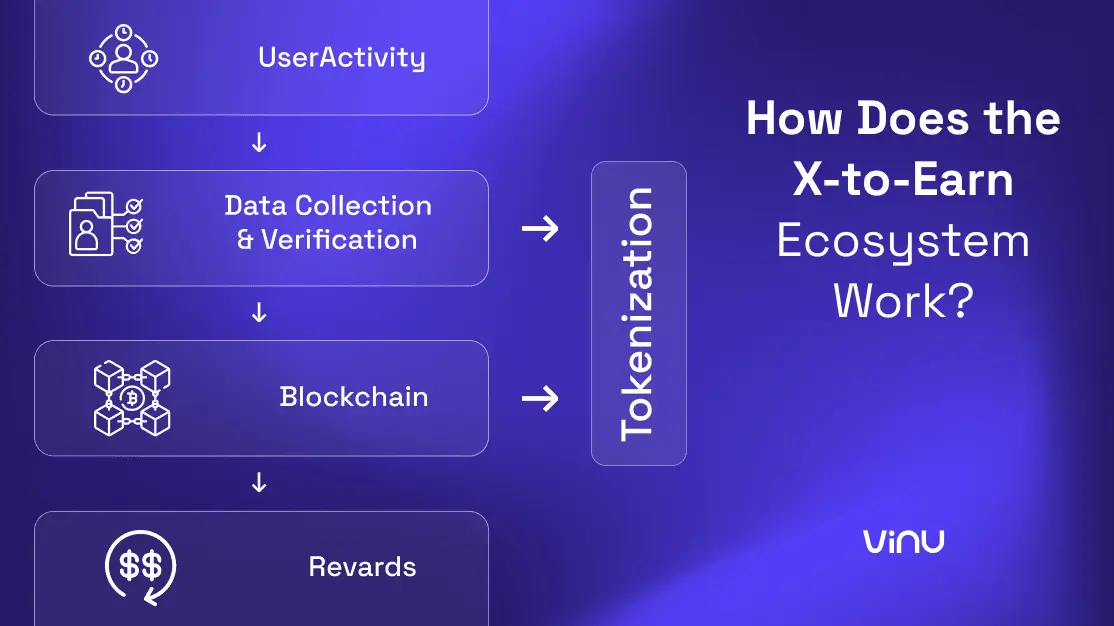
The X-to-Earn ecosystem is a blockchain-based participation model that rewards users for completing activities such as playing games, exercising, learning, creating content, or engaging with communities. It combines activity tracking, verification systems, tokenization, and smart contracts to connect user participation with digital rewards.
For Web3 applications, X-to-Earn offers an approach to user engagement that goes beyond traditional advertising. Instead of rewarding attention alone, platforms can recognize meaningful actions, encourage repeat participation, and build loyalty around their products.
However, sustainable results depend on reward economics, reliable verification, and genuine product value—not simply distributing tokens.
What Is X-to-Earn and How Does It Work?
X-to-Earn describes reward models in which users receive tokens, points, digital assets, or platform benefits for completing eligible activities.
The letter X represents the activity being rewarded.
Common examples include:
- Play-to-Earn (P2E): Rewards for participating in games.
- Move-to-Earn (M2E): Rewards linked to walking, running, or physical activity.
- Learn-to-Earn (L2E): Incentives for completing educational activities.
- Create-to-Earn (C2E): Rewards for producing content.
- Social-to-Earn (S2E): Incentives for community and social participation.
- Watch-to-Earn (W2E): Rewards for viewing eligible content.
- Read-to-Earn (R2E): Incentives for completing reading activities.
These models share a common structure: an activity is recorded, checked against eligibility rules, and converted into a predefined reward.
Blockchain becomes useful when projects need programmable token distribution, traceable transactions, or digital asset ownership.
Not every user activity must be recorded on-chain. Many applications process activity data off-chain and use blockchain only for selected reward operations.
The Technology Behind X-to-Earn Platforms
An X-to-Earn application typically combines five components.
Activity tracking: The application records actions through user interactions, game events, learning systems, or connected devices.
Verification: Backend services evaluate whether activities satisfy eligibility rules and detect potential abuse.
Reward engine: Configurable rules determine reward amounts, limits, schedules, and participant eligibility.
Smart contracts: Blockchain-based programs can manage token issuance, reward claims, transfers, and distribution.
Wallet integration: Compatible wallets allow users to access supported digital rewards.
These components connect conventional application infrastructure with blockchain functionality.
How IoT and Oracles Support Move-to-Earn
Move-to-Earn applications demonstrate how physical activity can generate digital rewards.
Consider a hypothetical application offering a fixed number of reward points when a user completes a defined step target.
A smartphone or smartwatch collects movement information using sensors and activity-tracking software.
The application checks this information against predefined rules, including activity limits and anti-fraud controls.
If the reward is distributed on-chain, verified activity information can be delivered to smart contracts through an appropriately designed oracle or integration service.
Oracles connect blockchain applications with external information. However, they do not automatically guarantee that the original sensor data is accurate.
GPS manipulation, simulated movement, duplicate submissions, and compromised devices remain important risks.
A reliable Move-to-Earn platform therefore needs both trustworthy data sources and effective verification procedures.
Real-World X-to-Earn Applications
STEPN: Movement-Based Rewards
STEPN became a prominent Move-to-Earn example after launching in 2021 and gaining attention in 2022.
The application connects physical activity with digital rewards and includes mechanisms intended to identify manipulated activity.
Its model demonstrates how fitness tracking and token-based participation can operate together.
Nevertheless, token earnings, asset values, and user participation depend on changing project rules and market conditions.
Environmental Participation: Aquapurge and Chatafisha
X-to-Earn models can also support environmental initiatives.
Aquapurge organized a community beach cleanup in Kenya where participants received digital rewards, including USDC and NFT recognition, following their contributions.
In Tanzania, Chatafisha has explored blockchain-based waste tracking and verified participation to support a circular economy.
These examples illustrate how environmental activities can be linked to verifiable records and incentive systems.
However, blockchain records alone cannot prove that waste was collected or environmental outcomes achieved. Physical verification and reliable reporting remain essential.
How X-to-Earn Supports User Loyalty
Traditional user acquisition often begins with advertising, impressions, and website visits.
X-to-Earn adds incentives connected to actual product participation.
Daily challenges, learning missions, contribution rewards, referral programs, and achievement systems may encourage users to return.
These mechanisms can improve engagement when rewards reinforce useful behavior.
For example, educational missions may introduce new users to product features, while contribution rewards can recognize valuable community activity.
However, poorly designed rewards can attract users interested only in collecting incentives.
Sustainable loyalty develops when users continue finding value after the reward campaign ends.
X-to-Earn vs. Traditional Digital Advertising
Traditional advertising and X-to-Earn serve different purposes.
Advertising primarily supports awareness, acquisition, and conversion. X-to-Earn focuses on participation, behavioral incentives, and retention.
An advertising campaign generally requires continued media spending, while a token-based system requires development, maintenance, verification, and ongoing reward funding.
Blockchain-based rewards can provide traceable transaction records, whereas advertising platforms rely on their own measurement systems.
Neither model is inherently more cost-effective.
Advertising may be better for reaching new audiences, while X-to-Earn can support deeper product engagement.
A combined strategy often makes more sense than replacing one model entirely.
Cost Considerations and Sustainable Token Economics
X-to-Earn development costs depend on application complexity, smart contracts, wallet integrations, security testing, reward mechanics, and operational requirements.
Projects must also consider transaction fees, data services, anti-fraud measures, customer support, and future reward funding.
The initial development budget is therefore only one part of the total cost.
Similarly, tokenization does not automatically create a self-financing community.
Reward emissions must be balanced against available resources and meaningful token utility.
Projects should evaluate customer acquisition cost, retention, reward expenditure, and lifetime value before making claims about long-term financial efficiency.
Why Vinu Digital for X-to-Earn Development?
Vinu Digital develops X-to-Earn applications combining participation models, configurable reward engines, smart contracts, wallets, and blockchain integrations.
Our modular approach supports activity verification, token distribution rules, user interfaces, backend services, monitoring, and optional anti-abuse controls.
Project requirements determine which components should operate on-chain and which should remain within conventional application infrastructure.
We also consider user experience and community communication alongside technical development. Reward mechanics should be clearly explained, supported by reliable product information, and aligned with the project's intended audience.
A Three-Stage Development Approach
1. Discovery and strategic design
Define the target audience, eligible activities, reward structure, token utility, network requirements, and operational constraints.
2. MVP and behavioral analytics
Develop essential workflows and test them with a limited audience. Track daily active users, retention, reward claims, customer acquisition cost, and user lifetime value.
3. Security and operational scaling
Expand infrastructure, strengthen activity verification, assess smart contract security, and introduce relevant compliance controls where applicable.
This approach helps businesses validate their model before committing to broader deployment.
Frequently Asked Questions
Does every X-to-Earn application need a cryptocurrency token?
No. Some applications use points, access rights, or other digital rewards. Blockchain tokens are appropriate when they serve a defined product purpose.
How are user activities verified?
Applications can use backend checks, device data, external services, or oracles. Verification quality depends on the reliability of these systems.
Can X-to-Earn guarantee user retention?
No. Incentives may improve participation, but long-term retention depends on product value, user experience, and sustainable reward design.
Build an X-to-Earn Platform with Vinu Digital
X-to-Earn connects user activities with programmable incentives, offering new opportunities for engagement, loyalty, and community participation.
Its success depends on integrating reliable verification, responsible token economics, secure software, and measurable business objectives.
Vinu Digital supports organizations developing X-to-Earn infrastructure, from reward architecture and MVP development to blockchain integration and operational scaling.
Contact our team to discuss an X-to-Earn model designed around your project.