

Crypto OTC trading is the negotiated buying or selling of digital assets outside a public exchange order book. OTC, short for over-the-counter, allows institutions and other large-volume participants to request tailored price quotes, coordinate counterparties, and arrange settlement under agreed conditions.
For a large Bitcoin purchase or sale, this structure can reduce the market impact associated with placing one substantial order on an exchange. However, OTC trading does not guarantee anonymity, unlimited liquidity, or risk-free execution.
Why Large Crypto Trades Can Move Markets
Imagine selling a large quantity of Bitcoin through a single market order. The exchange matches it against available buy orders at progressively lower prices.
If the best bid starts at $60,000 but the order consumes liquidity down to $58,000, the average execution price may be significantly below expectations.
This illustrates slippage, the difference between an expected execution price and the price actually received.
A large order can also reveal trading intentions and increase market impact. Institutional investors therefore need execution methods that account for liquidity, pricing, and discretion.
OTC trading provides an alternative by allowing participants to negotiate transaction conditions before execution.
What Is OTC Trading?
Over-the-counter trading predates cryptocurrency and has long been used in foreign exchange, bonds, and other financial markets.
In crypto markets, an OTC desk connects buyers and sellers or trades directly as their counterparty.
Instead of submitting the entire transaction to a public order book, participants negotiate pricing, volume, execution, and settlement conditions.
OTC services are particularly relevant to:
- Institutional investors: Firms managing substantial digital asset allocations.
- Hedge funds: Professional investment organizations entering or exiting large positions.
- High-net-worth individuals: Investors seeking negotiated execution for substantial transactions.
- Mining companies: Businesses selling digital assets to cover operational expenses.
- Corporate treasuries: Organizations managing cryptocurrency and stablecoin balances.
Centralized exchanges also support large transactions through various execution strategies. OTC is an additional trading model rather than the only available solution.
Why Do Institutions Use OTC Desks?
Reduced Market Impact
A negotiated block trade may avoid consuming the visible order-book depth of a single exchange.
However, liquidity providers may hedge their exposure through other markets, so indirect price effects remain possible.
Greater Trading Discretion
OTC negotiations are generally not displayed in public exchange order books.
This can help institutions manage sensitive trading intentions. Nevertheless, transactions are not necessarily invisible to counterparties, blockchain observers, compliance teams, or regulators.
Negotiated Pricing
An OTC desk may provide a firm quotation for a specified amount and validity period.
The agreed price can improve execution predictability, provided that the transaction satisfies its contractual conditions.
Flexible Liquidity Access
OTC desks may access their own inventories, institutional counterparties, and external liquidity providers.
The actual available liquidity depends on market conditions, supported assets, and counterparty capacity.
Customized Settlement
Participants can negotiate supported asset pairs, payment methods, settlement schedules, custody arrangements, and approval procedures.
This flexibility is particularly relevant to institutional treasury operations.
How Does an OTC Trading Platform Work?
Institutional OTC platforms frequently use a Request for Quote (RFQ) model.
A typical transaction follows five stages:
- Request: An institutional buyer specifies the asset, quantity, settlement currency, and transaction conditions.
- Pricing: The platform evaluates market prices, available inventory, spreads, and connected liquidity providers.
- Quotation: The buyer receives an executable proposal with a defined price, validity period, and applicable conditions.
- Acceptance: The parties accept the quotation under the platform's rules and establish their trading obligations.
- Settlement: The corresponding assets and funds are transferred, verified, and reconciled.
Principal vs. Agency OTC Desks
A principal desk trades using its own inventory and becomes the direct counterparty.
An agency desk arranges transactions between customers and other liquidity providers, generally earning an agreed fee.
Both models require appropriate risk management and operational controls.
A confirmed quotation can establish agreed pricing, but it does not eliminate counterparty default, funding, or settlement risk.
Security, KYC/AML, and OTC Settlement
Institutional OTC trading requires more than a private pricing interface.
Customer due diligence may include verifying corporate ownership, authorized representatives, transaction purposes, and source-of-funds information.
Anti-money-laundering controls, reporting obligations, and Travel Rule requirements depend on the applicable jurisdiction and participating institutions.
Escrow and Custody Arrangements
Some OTC transactions use regulated custodians or escrow structures to coordinate asset transfers.
Others operate through designated wallets, banking services, or custody accounts.
For supported crypto-to-crypto transactions, smart contracts may automate selected exchange conditions.
These mechanisms can reduce particular risks, but they do not eliminate custody failures, smart contract vulnerabilities, or counterparty exposure.
Settlement timing also depends on blockchain finality, banking schedules, asset availability, and contractual procedures. Same-day settlement may be possible but is not universal.
OTC Trading in Institutional Digital Finance
OTC infrastructure supports more than substantial Bitcoin purchases.
Corporate treasuries may use negotiated trading arrangements for portfolio rebalancing, stablecoin conversions, and digital asset liquidity management.
Stablecoins can support selected cross-border payment workflows, although fiat conversion, banking access, redemption conditions, and jurisdictional restrictions remain important.
RWA Tokenization and Secondary Markets
Tokenization introduces opportunities for negotiated transactions involving eligible digital representations of bonds, funds, property interests, and other assets.
These transactions may require investor eligibility checks, transfer restrictions, and specialized settlement arrangements.
Institutional DeFi Integration
Permissioned DeFi infrastructure may connect approved participants to programmable financial workflows.
Such integrations require technical security assessments, counterparty controls, and an appropriate regulatory framework.
The strategic value of OTC is its ability to coordinate these requirements, not a universal guarantee of better pricing or regulatory compliance.
Vinu Digital's OTC Trading Platform Development Services
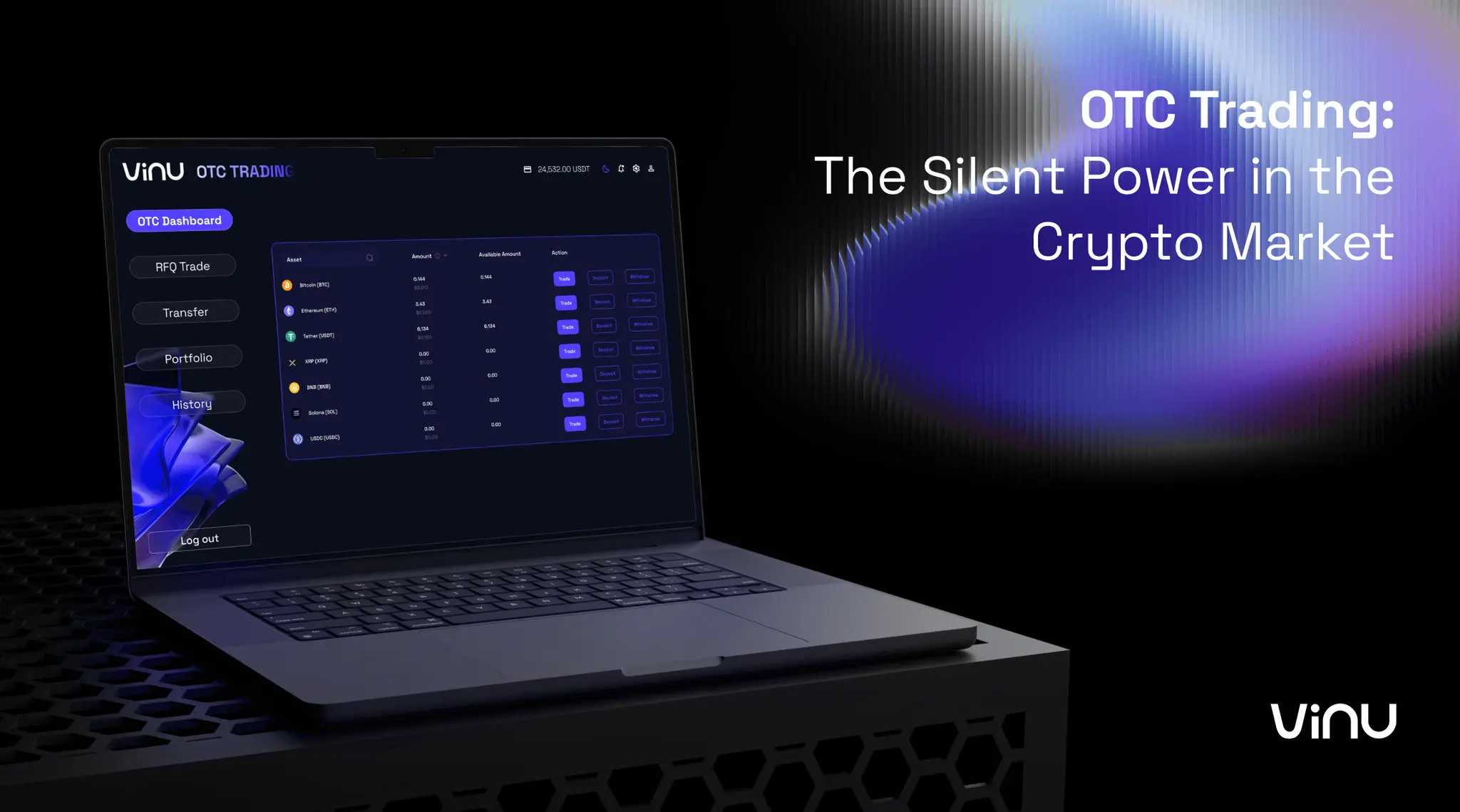
Vinu Digital develops configurable OTC trading infrastructure for cryptocurrency exchanges, brokerages, fintech companies, and institutional digital asset businesses.
Our approach combines structured execution workflows with pricing, settlement, permissions, and operational oversight.
Core OTC Platform Capabilities
- White-label interfaces: Configurable branding, institutional user roles, and transaction workflows.
- RFQ engine: Quote requests, pricing rules, validity periods, and acceptance procedures.
- Block trading: Controlled execution processes for supported crypto-to-crypto and crypto-to-fiat transactions.
- Pricing and spreads: Configurable market data sources, fees, spreads, and quotation parameters.
- Risk and approval controls: Role-based permissions, transaction limits, and multi-stage authorization.
- Counterparty management: Client records, trading permissions, and eligibility restrictions.
- Settlement coordination: Integration with wallets, custody, treasury, banking, and payment infrastructure.
- Reporting and audit trails: Transaction histories, approvals, settlement records, and reconciliation data.
These components help institutions build controlled OTC operations without developing every system independently.
Flexible Implementation Models
Vinu Digital supports turnkey OTC development, white-label solutions, and modular integration into existing financial platforms.
The exact capabilities and connected services depend on project requirements.
Vinu Digital provides the technology infrastructure. Licensing, liquidity commitments, custody arrangements, and regulatory responsibilities must be established by the operating institution and relevant authorized partners.
Frequently Asked Questions
Is OTC trading completely anonymous?
No. Negotiations may remain outside public order books, but regulated service providers must apply relevant identification, recordkeeping, and financial crime controls.
Does OTC trading guarantee zero slippage?
No. A firm quotation can establish agreed pricing under specified conditions. Quotes may expire, while counterparty and settlement risks remain.
Can OTC platforms support stablecoins and tokenized assets?
Yes, depending on asset availability, technical integration, counterparty arrangements, and applicable legal requirements.
The Future of Institutional OTC Markets
As digital asset markets mature, institutions increasingly need coordinated liquidity, flexible settlement, and stronger operational governance.
OTC platforms can connect traditional financial workflows with digital asset infrastructure, supporting institutional transactions alongside centralized and decentralized exchanges.
Vinu Digital helps organizations develop OTC software with configurable pricing, execution, settlement, and risk controls.
Contact our team to discuss your institutional OTC platform requirements.